Recognition
Face recognition extracts embeddings for identity verification and face search.
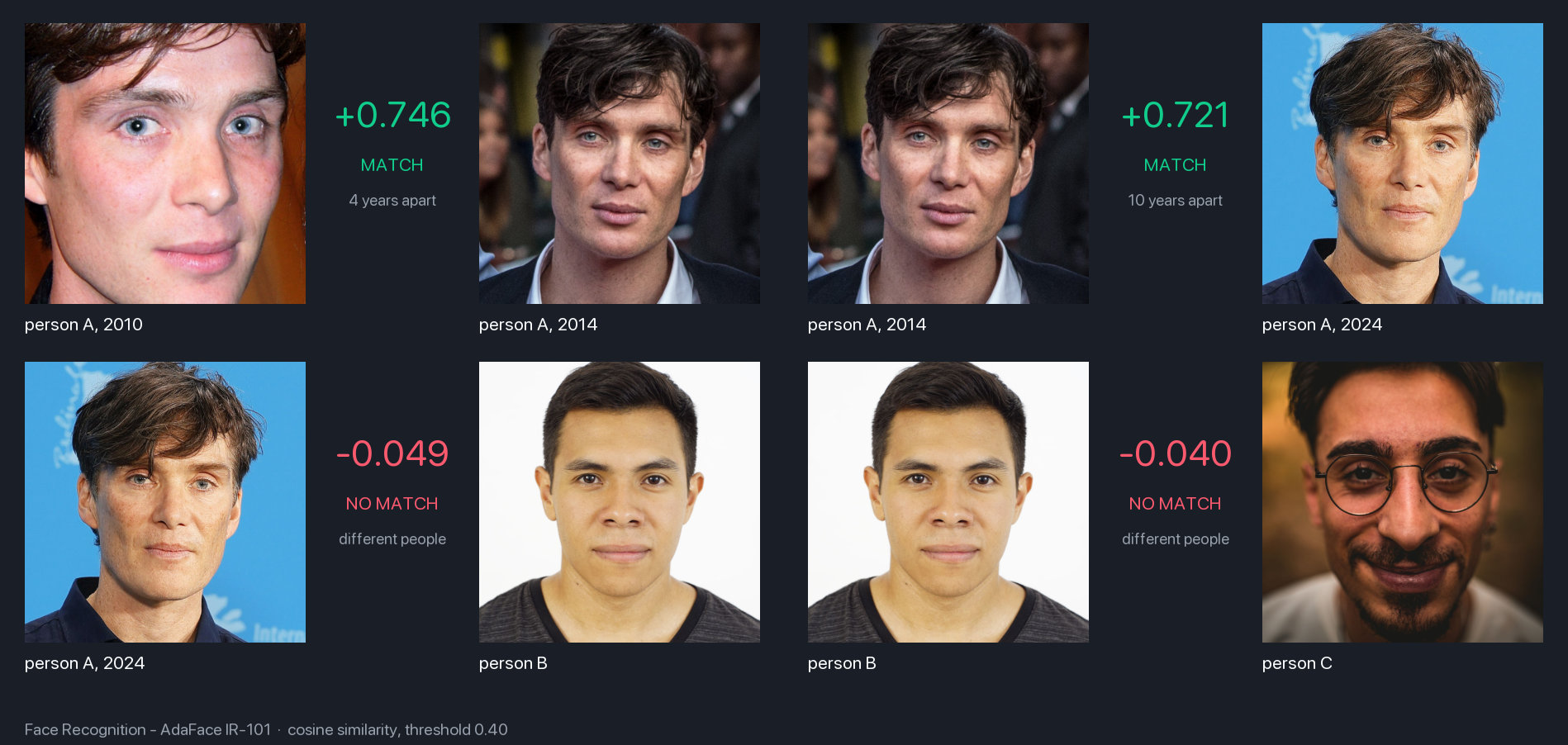
Available Models
| Model | Backbone | Size | Embedding Dim |
|---|---|---|---|
| AdaFace | IR-18/IR-50/IR-101 | 92-249 MB | 512 |
| ArcFace | MobileNet/ResNet | 8-166 MB | 512 |
| EdgeFace | EdgeNeXt/LoRA | 5-70 MB | 512 |
| MobileFace | MobileNet V2/V3 | 1-10 MB | 512 |
| SphereFace | Sphere20/36 | 50-92 MB | 512 |
AdaFace
Face recognition using adaptive margin based on image quality.
Basic Usage
from uniface.detection import RetinaFace
from uniface.recognition import AdaFace

detector = RetinaFace()
recognizer = AdaFace()

# Detect face
faces = detector.detect(image)

# Extract embedding
if faces:
    embedding = recognizer.get_normalized_embedding(image, faces[0].landmarks)
    print(f"Embedding shape: {embedding.shape}")  # (512,)
Model Variants
from uniface.recognition import AdaFace
from uniface.constants import AdaFaceWeights

# Lightweight (default)
recognizer = AdaFace(model_name=AdaFaceWeights.IR_18)

# High accuracy
recognizer = AdaFace(model_name=AdaFaceWeights.IR_101)

# Force CPU execution
recognizer = AdaFace(providers=['CPUExecutionProvider'])
| Variant | Dataset | Size | IJB-B | IJB-C |
|---|---|---|---|---|
| IR_18 | WebFace4M | 92 MB | 93.03% | 94.99% |
| IR_50 | WebFace4M | 166 MB | 95.44% | 96.98% |
| IR_101 | WebFace12M | 249 MB | - | 97.66% |
Benchmark Metrics
IJB-B and IJB-C accuracy reported as TAR@FAR=0.01%
ArcFace
Face recognition using additive angular margin loss.
Basic Usage
from uniface.detection import RetinaFace
from uniface.recognition import ArcFace

detector = RetinaFace()
recognizer = ArcFace()

# Detect face
faces = detector.detect(image)

# Extract embedding
if faces:
    embedding = recognizer.get_normalized_embedding(image, faces[0].landmarks)
    print(f"Embedding shape: {embedding.shape}")  # (512,)
Model Variants
from uniface.recognition import ArcFace
from uniface.constants import ArcFaceWeights

# Lightweight (default)
recognizer = ArcFace(model_name=ArcFaceWeights.MNET)

# High accuracy
recognizer = ArcFace(model_name=ArcFaceWeights.RESNET)

# Force CPU execution
recognizer = ArcFace(providers=['CPUExecutionProvider'])
| Variant | Backbone | Size | LFW | CFP-FP | AgeDB-30 | IJB-C |
|---|---|---|---|---|---|---|
| MNET | MobileNet | 8 MB | 99.70% | 98.00% | 96.58% | 95.02% |
| RESNET | ResNet50 | 166 MB | 99.83% | 99.33% | 98.23% | 97.25% |
Training Data & Metrics
Dataset: Trained on WebFace600K (600K images)
Accuracy: IJB-C reported as TAR@FAR=1e-4
EdgeFace
Efficient face recognition designed for edge devices, using an EdgeNeXt backbone with optional LoRA low-rank compression. Competition-winning entry (compact track) at EFaR 2023, IJCB.
Basic Usage
from uniface.detection import RetinaFace
from uniface.recognition import EdgeFace

detector = RetinaFace()
recognizer = EdgeFace()

# Detect face
faces = detector.detect(image)

# Extract embedding
if faces:
    embedding = recognizer.get_normalized_embedding(image, faces[0].landmarks)
    print(f"Embedding shape: {embedding.shape}")  # (512,)
Model Variants
from uniface.recognition import EdgeFace
from uniface.constants import EdgeFaceWeights

# Ultra-compact (default)
recognizer = EdgeFace(model_name=EdgeFaceWeights.XXS)

# Compact with LoRA
recognizer = EdgeFace(model_name=EdgeFaceWeights.XS_GAMMA_06)

# Small with LoRA
recognizer = EdgeFace(model_name=EdgeFaceWeights.S_GAMMA_05)

# Full-size
recognizer = EdgeFace(model_name=EdgeFaceWeights.BASE)

# Force CPU execution
recognizer = EdgeFace(providers=['CPUExecutionProvider'])
| Variant | Params | MFLOPs | Size | LFW | CALFW | CPLFW | CFP-FP | AgeDB-30 |
|---|---|---|---|---|---|---|---|---|
| XXS | 1.24M | 94 | ~5 MB | 99.57% | 94.83% | 90.27% | 93.63% | 94.92% |
| XS_GAMMA_06 | 1.77M | 154 | ~7 MB | 99.73% | 95.28% | 91.58% | 94.71% | 96.08% |
| S_GAMMA_05 | 3.65M | 306 | ~14 MB | 99.78% | 95.55% | 92.48% | 95.74% | 97.03% |
| BASE | 18.2M | 1399 | ~70 MB | 99.83% | 96.07% | 93.75% | 97.01% | 97.60% |
Reference
Paper: EdgeFace: Efficient Face Recognition Model for Edge Devices (IEEE T-BIOM 2024)
Source: github.com/otroshi/edgeface
MobileFace
Lightweight face recognition models with MobileNet backbones.
Basic Usage
from uniface.recognition import MobileFace

recognizer = MobileFace()
embedding = recognizer.get_normalized_embedding(image, landmarks)
Model Variants
from uniface.recognition import MobileFace
from uniface.constants import MobileFaceWeights

# Ultra-lightweight
recognizer = MobileFace(model_name=MobileFaceWeights.MNET_025)

# Balanced (default)
recognizer = MobileFace(model_name=MobileFaceWeights.MNET_V2)

# Higher accuracy
recognizer = MobileFace(model_name=MobileFaceWeights.MNET_V3_LARGE)
| Variant | Params | Size | LFW | CALFW | CPLFW | AgeDB-30 |
|---|---|---|---|---|---|---|
| MNET_025 | 0.36M | 1 MB | 98.76% | 92.02% | 82.37% | 90.02% |
| MNET_V2 | 2.29M | 4 MB | 99.55% | 94.87% | 86.89% | 95.16% |
| MNET_V3_SMALL | 1.25M | 3 MB | 99.30% | 93.77% | 85.29% | 92.79% |
| MNET_V3_LARGE | 3.52M | 10 MB | 99.53% | 94.56% | 86.79% | 95.13% |
SphereFace
Face recognition using angular softmax loss (A-Softmax).
Basic Usage
from uniface.recognition import SphereFace
from uniface.constants import SphereFaceWeights

recognizer = SphereFace(model_name=SphereFaceWeights.SPHERE20)
embedding = recognizer.get_normalized_embedding(image, landmarks)
| Variant | Params | Size | LFW | CALFW | CPLFW | AgeDB-30 |
|---|---|---|---|---|---|---|
| SPHERE20 | 24.5M | 50 MB | 99.67% | 95.61% | 88.75% | 96.58% |
| SPHERE36 | 34.6M | 92 MB | 99.72% | 95.64% | 89.92% | 96.83% |
Face Comparison
Compute Similarity
from uniface.face_utils import compute_similarity
import numpy as np

# Extract embeddings
emb1 = recognizer.get_normalized_embedding(image1, landmarks1)
emb2 = recognizer.get_normalized_embedding(image2, landmarks2)

# Method 1: Using utility function
similarity = compute_similarity(emb1, emb2)

# Method 2: Direct computation (embeddings are L2-normalized 1-D vectors)
similarity = np.dot(emb1, emb2)

print(f"Similarity: {similarity:.4f}")
Threshold Guidelines
| Threshold | Decision | Use Case |
|---|---|---|
| > 0.7 | Very high confidence | Security-critical |
| > 0.6 | Same person | General verification |
| 0.4 - 0.6 | Uncertain | Manual review needed |
| < 0.4 | Different people | Rejection |
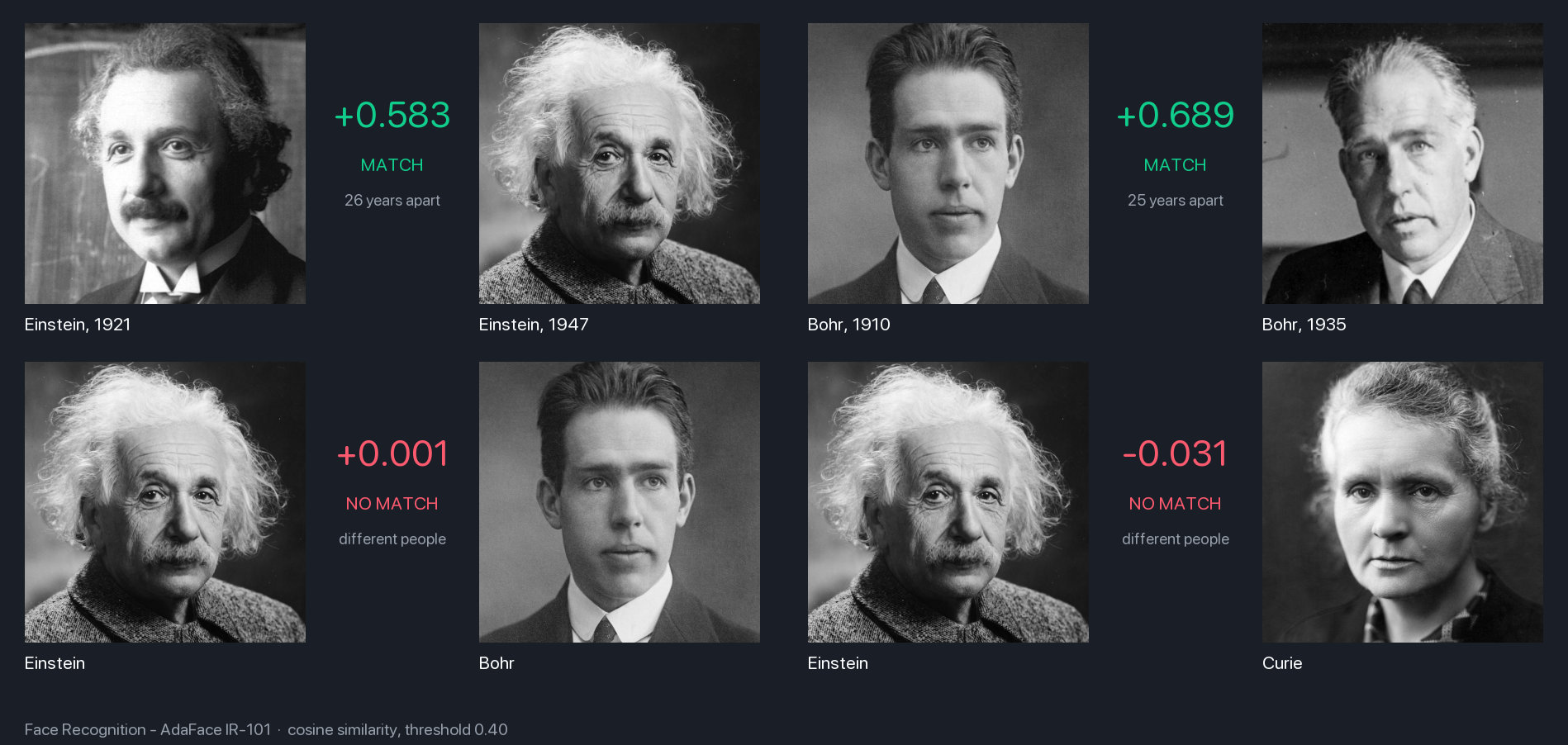
Those numbers show why the table above is a starting point, not a rule. A genuine pair 26 years apart lands at 0.583, below the 0.6 "same person" row, while the impostor pairs sit near zero. The gap between genuine and impostor stays wide, but the genuine floor drops with age gap, image age and scan quality. Calibrate the threshold on pairs that look like your own data.
Face Alignment
Recognition models require aligned faces. UniFace handles this internally:
# Alignment is done automatically
embedding = recognizer.get_normalized_embedding(image, landmarks)

# Or manually align
from uniface.face_utils import face_alignment

aligned_face, _ = face_alignment(image, landmarks)
# Returns: (112x112 aligned face, inverse transform matrix)
Building a Face Database
import numpy as np
from uniface.detection import RetinaFace
from uniface.recognition import ArcFace

detector = RetinaFace()
recognizer = ArcFace()

# Build database
database = {}
for person_id, image_path in person_images.items():
    image = cv2.imread(image_path)
    faces = detector.detect(image)

    if faces:
        embedding = recognizer.get_normalized_embedding(image, faces[0].landmarks)
        database[person_id] = embedding

# Save for later use
np.savez('face_database.npz', **database)

# Load database
data = np.load('face_database.npz')
database = {key: data[key] for key in data.files}
Face Search
Find a person in a database:
def search_face(query_embedding, database, threshold=0.6):
    """Find best match in database."""
    best_match = None
    best_similarity = -1

    for person_id, db_embedding in database.items():
        similarity = np.dot(query_embedding, db_embedding)

        if similarity > best_similarity and similarity > threshold:
            best_similarity = similarity
            best_match = person_id

    return best_match, best_similarity

# Usage
query_embedding = recognizer.get_normalized_embedding(query_image, landmarks)
match, similarity = search_face(query_embedding, database)

if match:
    print(f"Found: {match} (similarity: {similarity:.4f})")
else:
    print("No match found")
Available Recognizers
from uniface.recognition import ArcFace, AdaFace, EdgeFace, MobileFace, SphereFace

recognizer = ArcFace()
# or
recognizer = AdaFace()
# or
recognizer = EdgeFace()
See Also
- Detection Module - Detect faces first
- Face Search Recipe - Complete search system
- Thresholds - Calibration guide
- CLI Tools - Command-line scripts for all UniFace modules